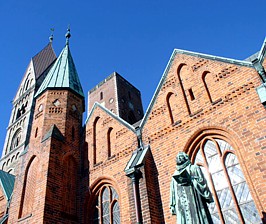
COPENHAGEN
CATHEDRAL
'The Church of Our Lady' |
Online
& Onsite Sightseeing - Copenhagen |
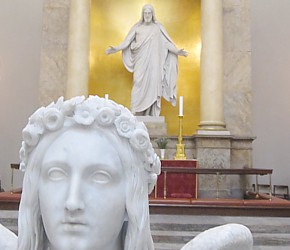
The
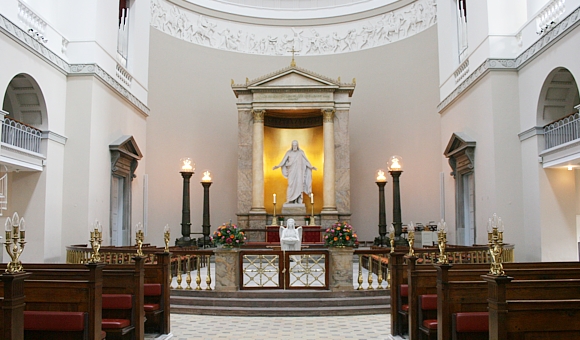
statue of Christ and the beautiful Baptismal font made
of Italian marble by Bertel Thorvaldsen. |
|
|
Copenhagen
Cathedral - 'The Church of Our Lady' |
|
Church since 1209
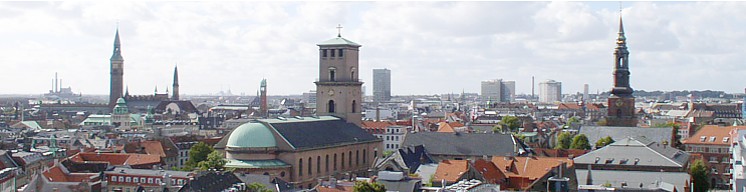
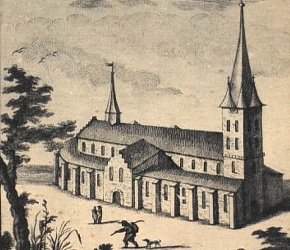
On the site where Copenhagen Cathedral (The Church of Our
Lady) is located - the area has housed several churches since
1209. The Cathedral has been rebuilt four
times - after the first church from 1209
of limestone - placed on the highest spot in town - burnt
down and was reconstructed in 1316 - then
when the second church was razed by a great fire in 1728
together with five other churches in Copenhagen and rebuilt
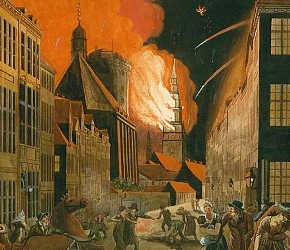
in 1738 - and finally during the bombardment
of Copenhagen in 1807 - when the spire was
hit by a Congreve rocket and nearly burnt the church down
to the ground. |
|
|
Since 1209 - A Church
has been built four time on the same place - and on the highest
spot in Copenhagen.
|
|
|
The
second Church in 1520 |
The
second Church built in 1520 was the church of the Danish Royal
House and conducted all ceremonial handling's like crowning
and weddings for the Royals. The church burnt down in 1728
together with five other churches during the heavy fires in
Copenhagen. |
|
|
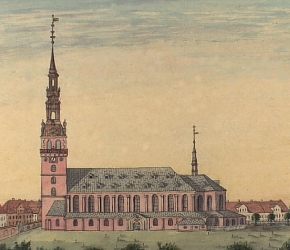
The
third Cathedral from 1738 |
In
1738 the third Church was built with the highest tower and
spire in Copenhagen, and was raised by a fire in 1807 during
the bombardment of the city. The Royal House had selected
the Palace Chapel at Christiansborg Palace as their future
parish church in 1732. |
|
|
The
Royal & National Cathedral - 1924 |
|
Copenhagen
Cathedral
- Denmark |
|
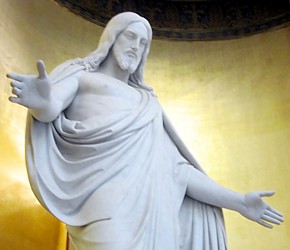
The
Statue of Christ created by sculptor Bertel Thorvaldsen.
Copenhagen Cathedral. |
|
The
Royal Cathedral
The Cathedral had for a long time been associated with the
Royal family - where the Royal House used
the Church (Cathedral) for their ceremonial events such as
crowning and weddings. The first royal ceremony in the second
Church (Cathedral) from 1316 was when King
Valdemar IV - nickname Atterdag - (Tomorrow - there
is also a day) - (1320-1375 - ruled Denmark 1340-1375) let
his ten-year old daughter Margrethe - later
Queen Margrethe I - marry to King
Haakon of Norway in 1363 - and then
when King Christian I and Queen Dorothea
were crowned and married in 1449 - the (Cathedral)
obtained the status of being the prime Church for the Royals.
Reformation 1536 and national church
After
the crowning in 1536 of King Christian
III in the former rebuilt Cathedral - and in the
same year - when the King introduced the Protestant
Reformation - and abolished Catholicism -
then all Danish Churches became Evangelical Lutheran
- where the Danish mother tongue was allowed and future services
was conducted in Danish according to the Evangelical
Lutheran order and traditions. The Church
of Our Lady became the main Cathedral of
Copenhagen in 1924 - and was appointed
as Denmark's National Cathedral.
|
|
Battle
of Copenhagen (1801-1807) |
The
Battle of Copenhagen
- 1807 |
The
Second Battle of Copenhagen in September 1807, was a
British attack on the civilian population of Copenhagen,
with over 14,000 rounds fired in three days. More than
2000 civilians were killed and 30% of the buildings
were destroyed. |
|
|
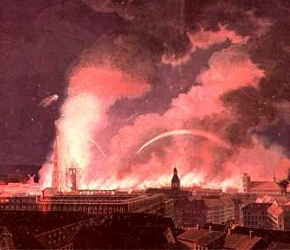
Copenhagen
Burning - 1807 |
Painting
by C. W. Eckersberg showing the spire of the current
Cathedral on fire during the bombardment of Copenhagen
in 1807. The Round Tower and the Trinitatis church complex
to the left - survived the daily attacks on the city. |
|
|
Copenhagen
was attacked by the
British Armada
in 1807 - and many historical buildings
were destroyed.
|
|
|
Battle
of Copenhagen (1801-1807)
The background for the battles was the result of multiple
failures of diplomacy in the end of 1800
and the beginning of 1801 during the Napoleonic
wars. To size the Danish fleet to avoid its ending
up in the hands of Napoleon - the naval Battle of Copenhagen
(Slaget på Reden) was fought in April 1801
by the British fleet under the command of Admiral Hyde Parker
Jr. The main attack was led by Vice-Admiral Horatio
Nelson - who famously disobeyed Parker's order to
withdraw and destroyed many of the Danish-Norwegian ships
before Denmark-Norway agreed to a truce.
Attack on the civilians and buildings
The Second major Battle of Copenhagen in September 1807
was a British attack on the civilian population of Copenhagen
and buildings - among them Copenhagen’s present Cathedral
and the neighbouring University. The British fired 5,000
rounds into Copenhagen on the first night of bombardment -
only 2,000 rounds into the city on the second
night - and 7,000 rounds on the third night.
More than 2,000 civilians were killed and
30% of the buildings were destroyed during
the battle. The bombardment had included Congreve Rockets
- which caused many fires. In October 1807
the British fleet left Copenhagen for England. The war continued
up to 1814 - until the Treaty of Kiel was
signed. |
|
The new Church was inaugurated around 1840 - and can
seat more than 1500
church goes.
The
famous Danish sculptor Bertel Thorvaldsen was assigned
to decorate the interior of the current Cathedral.
|
|
|
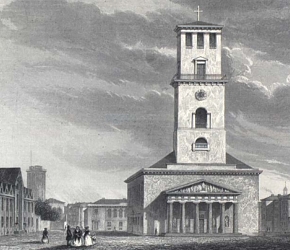
The
new Church was inaugurated in 1840 |
The
newly built Church and current Cathedral in 1840, with
the University building on the left - and the Round
Tower from 1642 at the back. The University was ruined
by fire in 1801 and rebuilt in 1836. |
|
|
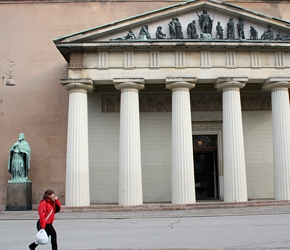
The
prestigious pediment from
1862 |
The
imposing and prestigious
pediment from 1862 supported by columns is created by
the architect C. F. Hansen
in neoclassical style -
and the Pantheon Temple in Rome was used as a model. |
|
|
Copenhagen
Cathedral Data
The building length of the entire Cathedral is 83
m - and the total width is 33 m.
The nave is 60 m long - and over 25
m from floor to ceiling. With all galleries open
- the church can seat more than 1500 people.
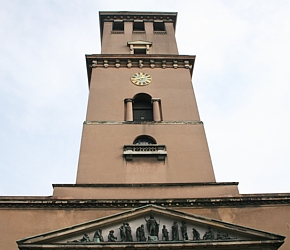
The tower is 60 m high and houses the four
church bells that weigh over 4 tons - and
are the largest bells in Denmark. The smallest bell in the
tower is the oldest bell in the country - dating from 1490. |
|
The
present tower building is 60 m high and houses the four
church bells that weighs over 4 tons, which are the
largest bells in Denmark. The smallest bell in the tower
is the oldest bell in the country - dating from 1490.
The church became the main Cathedral of Copenhagen in
1924. |
|
|
John
the Baptist's preaching in the tympanumon |
|
The
present columns from 1862 outside of the main entrance
of Copenhagen Cathedral. The tympanumon displays John
the Baptist's preaching. Many buildings around the town
were attached with pediments - which belongs to the
neoclassical style in the middle of the 1900 century. |
|
|
Copenhagen
Cathedral is built in neoclassical style
-
after the foundation stone of the
present Cathedral
was laid in
1817.
|
|
|
Consecrated
in 1829
After the bombardment of Copenhagen
in 1807 - where most of the Cathedral was
destroyed and after being a ruin for almost ten years -
King Frederik VI (1768-1839)
- ruled Denmark 1808-1839 and Norway 1808-1814)
laid the foundation stone of the present
Cathedral in 1817 - and the current Cathedral
was consecrated on Whitsun Day in 1829
- after being under construction and rebuilding for nearly
twelve years. It was the architect C. F. Hansen who was
given the task to design the new modern Cathedral in a neo-classical
style with a dome - a colonnade and a prestigious fronton
(pediment) supported by columns. |
|
|
Bertel Thorvaldsen has created and decorated the entire
Cathedral with his marvellous
sculptures in marble of Christ and the twelve Apostles
plus the Baptismal font.
|
|
|
Bertel
Thorvaldsen's Sculptures |
Bertel
Thorvaldsen's sculptures of the Apostles Jacob (James,
son of Zebedee) and Paulus (Paul of Tarsus) are being
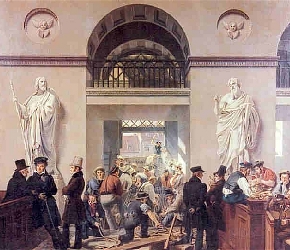
set up in 1834 alongside the nave of the church. Painting
by Niels Simonsen. |
|
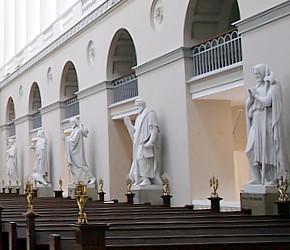
All
twelve Apostles are placed as decorative monuments on
either side of the nave in the Cathedral and each statue
represents a symbol that is associated with each apostle. |
|
|
|
The
interior and decoration by Bertel Thorvaldsen
The famous Danish sculptor Bertel Thorvaldsen was
assigned to decorate the interior of the Cathedral by creating
the sculptures of Christ and the twelve Apostles together
with the font. The statue of Christ above
the altar captures the attention and creates a peaceful atmosphere
for the entire church with its gentle welcoming gesture.
The
twelve apostles are placed in the nave and each statue
represents a symbol that is associated with each apostle.
In front of the altar is the beautiful baptismal font
made of Italian marble and shaped like a guardian angel that
holds the font. The font and the rest of the marble works
in the church was Bertel Thorvaldsen's personal gift to the
church.
|
|
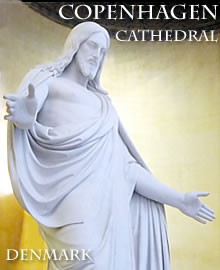
The
Statue of Christ - Copenhagen Cathedral |
|
The
statue of Christ by sculptor Bertel Thorvaldsen above
the altar - captures the attention and creates a peaceful
atmosphere in the entire Cathedral for church goers
with its gentle and graceful welcoming gesture. |
|
|
The
Baptismal Font - Copenhagen Cathedral |
|
The
beautiful Baptismal Font made of Italian marble and
shaped like a guardian angel that holds the font. The
font and the rest of the marble works in the church
was Bertel Thorvaldsen's personal gift to the church.
|
|
|
The
statue of Christ & the beautiful Baptismal Font
are fabulous master pieces by Danish sculptor Bertel
Thorvaldsen.
|
|
|
The
Cathedrals Bishops and Deans
In the aisles a bronze bust of Bertel Thorvaldsen - modelled
by H.W.Bissen - is on display along with many portraits of
the Cathedrals Bishops and Deans. |
|
|
Copenhagen
Cathedral can seat 1500 Congregants |
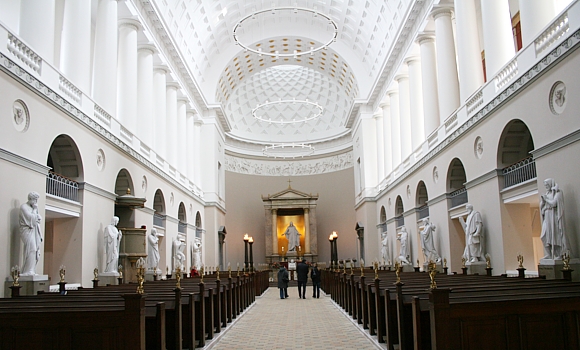
There
is over 25 m from floor to ceiling and the nave is
60 m long - here with the twelve Apostles and the
statue of Christ at the altar. The Cathedral can seat
1500 congregants. |
|
|
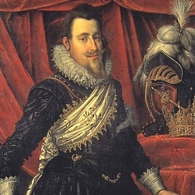
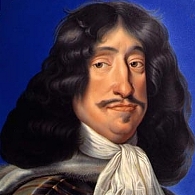
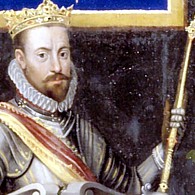
Royal Events and Prominent Funerals
| King
Christian IV - also known as the architect
of Copenhagen was crowned in 1596
in the Cathedral. The King was the
builder of Rosenborg Castle - Round
Tower, Old Stock Exchange - etc. |
|
| King
Frederik III - founder of the absolute
monarchy in 1665 was crowned in 1648
in the Cathedral. The King had a passion
for collecting books and created the
Royal Library in 1648. |
|
|
Sculptor
Bertel Thorvaldsen |
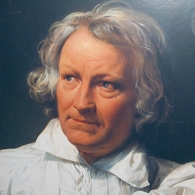
| The
funeral of master sculptor Bertel
Thorvaldsen took place at the Cathedral
in 1844. Bertel Thorvaldsen was assigned
to decorate the interior of the entire
Cathedral. |
|
1363
- The wedding
of Margaret I of Denmark
(1353-1412 - ruled Denmark, Norway and Sweden
1375- 1412) and Haakon VI
Magnusson of Norway - Margaret I is buried
in Roskilde Cathedral.
1449 - October 28 - The
crowning and marriage
of King Christian I of
Denmark (1426-1481 - ruled Denmark - Norway
and Sweden 1448-1481) and Queen
Dorothea of Brandenburg - King
Christian I is buried in Roskilde Cathedral.
1536 - The crowning
of King Christian III of
Denmark (1503-1559 - ruled Denmark and Norway
1534-1459) - Buried in Roskilde Cathedral.
1559 - The crowning
of King Frederik II of
Denmark (1534-1588 - ruled Denmark and Norway
1559-1588) - Buried in Roskilde Cathedral.
1596 - August 17 - The
crowning of King
Christian IV of Denmark (1577-1648
- ruled Denmark and Norway 1588-1548) -
Buried in Roskilde Cathedral. |
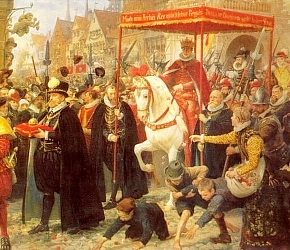
| One
of the many ceremonial events at the
Cathedral was the crowning of King
Christian IV in 1596. The coronation
procession started at Copenhagen Castle
and went through the city to Copenhagen's
Cathedral - where the crowning ceremony
took place. The royal event was later
painted by Otto Bache in 1887. |
|
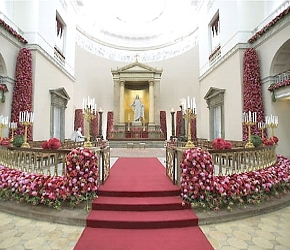
| At
the Royal wedding in May 2004 of Crown
prince Frederik and Mary Elizabeth
Donaldson - a marvellous floral decoration
at the Alter and Chancel steps of
the Cathedral was masterly created
by royal floral designer Erik Buch
in close collaboration with the mother
of the groom Queen Margrethe II. |
|
1648
- The crowning of King
Frederik III of Denmark (1609-1670
- ruled Denmark and Norway 1648-1670) -
Buried in Roskilde Cathedral.
1844
- 30 March - Funeral of
Bertel Thorvaldsen (1770-1844)
- Sculptor and the master of decorating
Copenhagen’s Cathedral - Buried in
a tomb in the inner courtyard of his museum.
1855 - November 18 - Funeral
of Søren A. Kierkegaard
(1813-1855) - World known Danish philosopher
and theologian - Buried at Assistens Cemetery
in Copenhagen.
1875 - 11 August - Funeral
of Hans Christian Andersen
(1805-1875) - World known writer - Buried
at Assistens Cemetery in Copenhagen.
1931 - Funeral
of Carl Nielsen (1865–1931)
- International Danish composer and national
hymn writer. Buried at Vestre Cementary
in Copenhagen.
2004 - May 14 - The Royal
wedding of Crown Prince
Frederik (XI) of Denmark and Mary
Elizabeth Donaldson - Australia
- later Crown Princess Mary. |
|
Philosopher
Søren A. Kierkegaard |
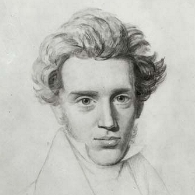
| The
funeral of philosopher and theologian
Søren A. Kierkegaard took place
at the Cathedral in 1855. Best known
for his work about existential psychology. |
|
|
Author
Hans Christian Andersen |
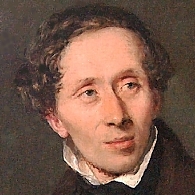
| The
funeral of world famous writer and
poet Hans Christian Andersen took
place at the Cathedral in 1875. Best
known for his many fairy tales. |
|
| The
crowning of King Frederik II of Denmark
(1534-1588 - ruled Denmark and Norway
1559-1588) - Buried in Roskilde Cathedral. |
|
|
|
|
|
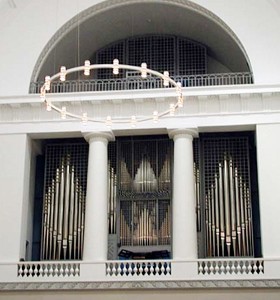
The
Organ
The great Cathedral organ with 87 stops and
5 manuals and pedal - and was inaugurated
on Easter Sunday 9 April - 1995 - with a
choir organ added in 2002. The entire organ
unit is built by the world’s oldest organ-builders Marcussen
& Son - who are based in south Jutland - Denmark.
The company was founded in 1806 by Jürgen
Marcussen (1781-1860) in Aabenraa and the firm has during
the years achieved international reputation - with a reference
of 1125 organs built and supplied worldwide.
|
|
|
The entire organ unit
is built by the world’s
oldest organ-builders
Marcussen & Son.
Copenhagen Cathedral is
located in the heart
of Copenhagen.
|
|
The
great organ in the Cathedral was inaugurated in 1995
and is built by a Danish company and the world’s
oldest organ-builders Marcussen & Son. |
|
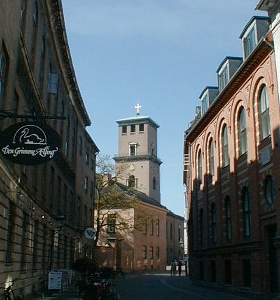
The
Cathedral is located in the heart of the city and in
the Latin Quarters of the town - next to the University
of Copenhagen. |
|
|
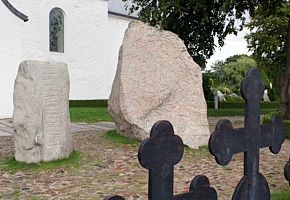
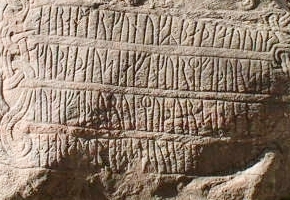
The
Runic Stones - Jelling - Jutland |
Brief
History - The National Church of Denmark
The Danes became Christians more than 1000 years
ago - when the Danish King Harald Bluetooth
raised his great Runic Stones at Jelling in
Jutland around
965 A.C. - stating that Christianity
had come to Denmark. King Harald Bluetooth's
Runic
Stone at Jelling is recognised as a National
Symbol - and the Danish Kingdom's Birth Certificate.
The runic inscription on the biggest of the two runic stones
- placed beside each other - praises King Harald Blutooth
(Gormson) for making all Danes Christians
in the 10 century. The little runic stone - erected by King
Harald Blutooth's father “King Gorm the Old”
(Gorm den Gamle) in memory of his wife Queen Thyra
Dannebod - is strongly identified by the engraved
inscription that testifies the creation of Denmark as a nation.
|
|
The
big runic stone at Jelling in Jutland was raised by
King Harald Bluetooth in 965 stating that the Christian
religion had come to Denmark and was rooted among the
Danes. The stone has a figure of Christ on one side
and on another side a serpent wrapped around a lion
with runic alphabets. |
|
|
Birth
Certificate
of Denmark |
The
inscription of the big runic stone pronounces that “King
Harald made this monument in memory of his father Gorm,
and in memory of his mother Thyra. "The Harald
who won the entire Denmark and Norway and made all the
Danes Christian." The runic stones are great tourist
attractions. |
|
|
"The Harald who won
the entire Denmark and Norway and made all Danes Christian".
|
|
|
The
National State Church of Denmark - The Evangelical
Lutheran Church |
| Altar
painting from 1561 - after the Reformation in 1536 -
showing the three most important acts of the Danish
Lutheran Church - Baptism - Holy Communion and Sermons.
|
| The
Reformation Memorial Obelisk is situated right opposite
The Cathedral of Copenhagen - and commemorates the Protestant
Reformation in Denmark 1536. |
|
State
and National Church
Since the Danish Constitution was introduced in 1849
- the Danish Church became a State Church
and belongs to the Evangelical Lutheran Church
of Denmark - officially supported by the state
and is an outcome from the Lutheran Reformation in 1536.
The Danish parliament ("Folketinget") is the
supreme legislative authority for the church.
See:
History of Copenhagen
Church - and the Democratic Era in Denmark
Religion and Democracy has always played a vital role
in Denmark since the protestant reformation in 1536
- during the reign of King Christian III
(1503- 1559 - King of Denmark and Norway 1534-1559).
The reformation was accomplished peacefully - while
Lutheranism was spread throughout Denmark
and other Scandinavian countries - and luckily for the
Danes - the Danish National Church
was establish with an Evangelical Lutheran
background that was active and engaged in the Democratic
Era - as well as becoming the Danish state
religion.
The
Danish Culture and Democracy
The Danish Culture and Democracy
has grown out of Christianity in Denmark
- and is the cornerstone and fundamental base of the
Danes democratic mindset and cultural
upbringing. The Danish State Church
has constantly reformed itself - and is plaited into
the modern and high end developed Danish society by
practicing the Danish way of worshiping Christianity
- as well as a freethinking belief in Evangelical Lutheran
values and traditions.
|
The
Web-site for The Danish National Church (Folkekirken -
The Peoples Church)
See: www.folkekirken.dk
(English) |
|
Visitors
and "The Holy Communion"
A vast majority of all ethnic Danes
are members of the Evangelical Lutheran and
Protestant Church of Denmark - called
"Folkekirken" (The Peoples
Church). Many Lutheran churches with great historical
and cultural importance are placed in Copenhagen - and
open for tourists 7 days a week. All
visitors are welcome to participate in the church service
and take part of the "Holy Communion".
See: Churches
in Copenhagen
Cathedral’s and Churches in Denmark
There are over 2,400 Evangelical Lutheran
and Protestant Cathedral’s and Churches
spread all over the Danish Kingdom - and one of the
oldest Cathedrals in daily function is the medieval
Ribe Cathedral from around 1140
- and situated in south west Jutland. The oldest Evangelical
Lutheran and Protestant Church in daily function in
Denmark - is the medieval Sankt Jørgensbjerg
Kirke in Roskilde from 1080
- and located in mid Sealand. |
|
Medieval
Ribe Cathedral from around 1140 - and situated in south
west Jutland. |
|
|
OTHER
RELIGIOUS DENOMINATIONS IN DENMARK |
| Places
of Worship for World Religions
in Denmark |
Numerous
Churches and Places of Worship
belonging to other religious denominations than Evangelical-Lutheran
are located around Denmark - Copenhagen and in other
major Danish cities - where Tourists and Visitors can
attend Religious and Worship Services - as the following
World Religions are represented and offer Places
of Worship: Baptist
- Buddhist - Charismatic
- Christian Scientist - Church
of England - Hare Krishna
- Hinduism - International Christian Ministry
- Islam - Jehovah's Witnesses
- Judaism - Methodist
- Mormon - Orthodox Christians
- Pentecostal - Quaker - Roman
Catholic - Russian Orthodox
- Salvation Army - Seventh
Day Advent - Sikhism - plus
many more denominations that practice their religion
and religious beliefs in Denmark. |
|
|
Location
- Copenhagen's Cathedral (Københavns Domkirke)
The Cathedral (Københavns Domkirke)
is
located in the heart of the old Latin Quarters and beside
Copenhagen’s University - St. Petri Church - and the
pedestrian Street “Strøget”. |
|
Copenhagen's
Cathedral - The Church of Our Lady
Address:
Copenhagen’s Cathedral - Vor Frue Kirke
Nørregade 8
1165 Copenhagen K
|
|
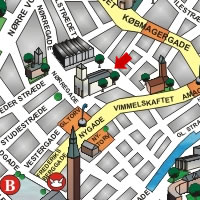
|
Copenhagen's
Cathedral
(Københavns Domkirke) |
|
|
We
can take you Here - There & Everywhere in and around Denmark! |
|
Excursion
and field trips - plus exclusive sightseeing tours
Our Inbound Travel Service Team offers comprehensive Excursion
and field trip to
Historic Castle - Cathedrals and Churches - plus Cultural
Palaces & Museums |
TRANSFERS
- TOURS - CONFERENCES - JOINT VENTURES - EVENTS - ACCOMMODATIONS
- TRAVEL INCENTIVES ETC. |
Select
venture and service:
Click event for more info! |
|
|