|
The
Yellow Palace and the foundation of the Glücksborg Dynasty
The
Yellow Palace is an interesting historic
building from 1764 in Louis Seize style and
designed by the French architect Nicolas Henri Jardin for
the merchant H.F. Bargum.
In 1810 King Frederik VI (1768-1839 - ruled
1808–39) acquired the mansion as a residence for relatives
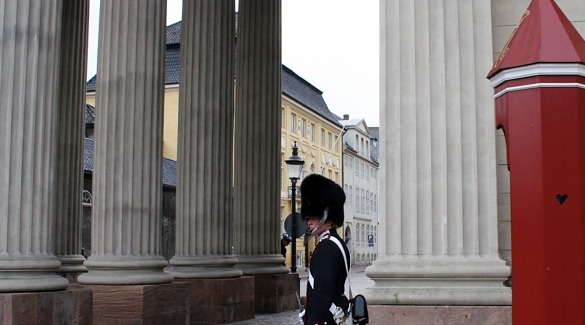
of the Royal family. The Yellow Palace is situated right at
the side of Amalienborg Palace and presently used as the administrative
part of the Royal Household called the Lord Chamberlain’s
Office
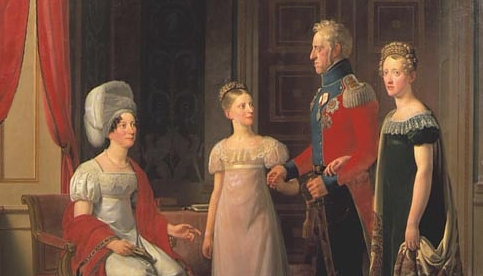
| King
Frederik VI with Queen Marie and Princess Caroline
and Vilhelmine – painted by C.W. Eckersberg
in 1821. The King acquired The Yellow Palace in
1810 and handed it over to his favourite nephew
Prince Christian from Glücksborg in 1837
- later King Christian IX. |
|
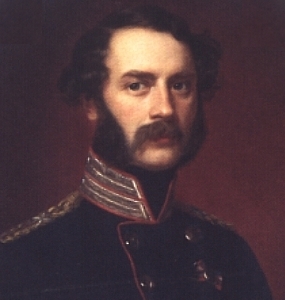
Prince
Christian and Princess Louise In
1837, the Yellow Palace was handed over by
King Frederik VI to his favourite nephew Prince Christian
from Glücksborg - Germany, who was a young officer building
up a career in the Royal Danish Horse Guard. In 1842
Prince Christian married Princess
Louise of Hessen who was a niece of King Christian
VIII (1786-1848 - ruled Denmark 1839-48 and was briefly King
of Norway in 1814). The newly wedded couple started their
new life in the Yellow Palace, which was a very modest residence
and home for the Glücksborg family the next 22 years.
In 1843 the first child was born and given
the name Frederik – who became King Frederik
VIII, 63 years later.

In
1842 Prince Christian married Princess Louise
of Hessen and was building up a career in the Royal
Danish Horse Guard. The Prince was nephew to Queen
Marie Sophie Frederikke, wife of King Frederick
VI. |
|
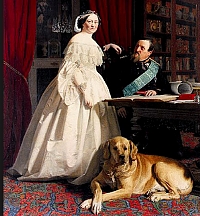
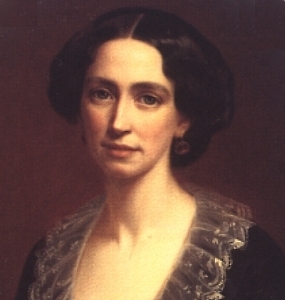
| Princess
Louise of Hessen was a niece of King Christian VIII
and gave birth to six extremely successful children,
who expanded the Glücksborg line of royalties
all over Europe. |
|
At
that time no one could imagined that Prince Christian of Glücksborg
and Princess Louise of Hessen one day would rule the Danish
Kingdom and be the King and Queen of Denmark.
After
the birth of Frederik in 1943, Princess Louise
gave birth to five children in the following years - Alexandra
in 1844 - Vilhelm in 1845 –
Dagmar in 1847 – Thyra in
1853 and Valdemar in 1858. Prince Valdemar
lived in The yellow Palace to his death in 1939 and was the
last Royal person who resided here.

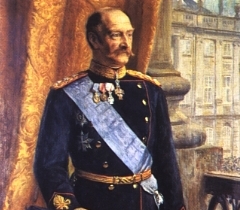
| Portrait
of King Frederik VII 1861 – was the last Oldenborg
monarch. |
|
The
last Oldenborg King
During the past years the Glücksborg’s familiy
fortune began to improve when the childless King
Frederick VII being the last representative of
the Royal House of Oldenburg (1808-1863
– ruled 1848-63) recognized Prince Christian as
his heir to the Danish throne in 1852.
King Frederik VII signed the first Danish Constitution
in 1849, which mainly gave all Danes
their democratic rights and governing is still based on
these more than 150 year old reforms.
King Frederik VII was the last Oldenborg King and the
first constitutional monarch in Denmark. |
Prince
Christian of Denmark and King Christian IX
Prince Christian was not the closest relative to the throne,
but belonged to a branch of the Royal House of Oldenburg and
grew up here too under the guidance of his maternal aunt Queen
Marie Sophie Frederikke, wife of King Frederick VI.
Prince Christian was also a great-grandson of King Frederick
V of Denmark, through his mother Louise Caroline, Duchess
of Glücksborg, whose mother Luise (Landgravine of Hesse)
was the daughter of King Frederik III.
After
negotiations and mutual understanding between the great powers
and the other Nordic countries the Treaty of London
was signed in 1852, accepting Prince Christian
as successor to the Danish throne. In agreement with the Act
of Succession of 1853, Prince Christian was officially
appointed and named Prince Christian of Denmark.
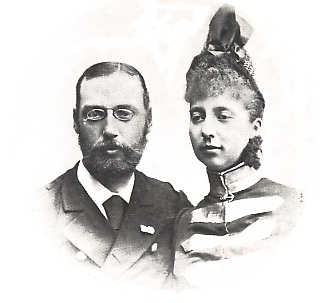
| The
Yellow Palace in 1880 with the Royal Life Guard
guarding the building, while Prince Valdemar of
Denmark and Princess Marie de Orleáns-Bourbon
is in residence. Prince Valdemar was the last
Royal person, who lived in The Yellow Palace until
his death in 1939. |
|
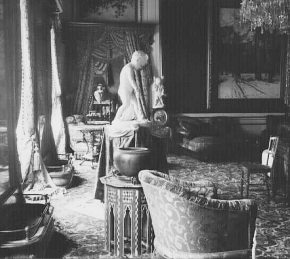
| Interior
from the living room during the residential period
of Prince Valdemar of Denmark around 1890. The heavy
furniture and stylish decoration is typical for
the Victorian era, with upholstered furniture and
elaborate drapes as well as various ornaments. |
|
On
the death of Frederik VII in 1863 - Prince
Christian acceded the throne as King Christian
IX - and became the first patriarch and founder of
the Glücksborg dynasty.The Royal family moved into the
Schacks mansion in 1865 at Amalienborg –
later called Christian IX’s Palace
where the King lived until his death in 1906.
The former Kings palace was attractively renovated in 1967
and is now the residence of Queen Margrethe
and her husband Prince Consort Henrik. The
present Royal Family are direct descendants of the Royal House
of Glücksborg.
King
Christian IX and Queen Louise gave
birth to six extremely successful children - who all contributed
to expand the Glückborg line of royalties into dynastic
relations with the most influential European Royal
and Princely houses. All six brothers and sisters
were born at The Yellow Palace.
-
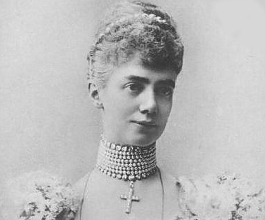
Crown Prince Frederik of Denmark (1843-1912
– ruled 1906-12) - later King Frederik VIII
of Denmark. Married to Princess Lovisa of Sweden.
King
Frederik VIII - 1910. Painting by Otto Bache.
|
|
Queen
Lovisa -1910. Painting by Otto Bache. |
|
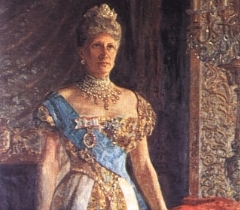
| King
Frederik VIII – ruled from 1906-12 and was the eldest
son of King Christian IX, who married Princess Lovisa
of Sweden - later Queen Lovisa and daughter of the king
of Sweden Carl XV. The Royal couple had four sons and
four daughters. |
-
Princess Alexandra of Denmark (1844-1925) -
later the Queen consort of the United Kingdom. Married to King
Edward VII of the United Kingdom.
| |
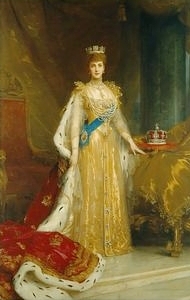
Queen
Alexandra - Coronation -1902 |
|
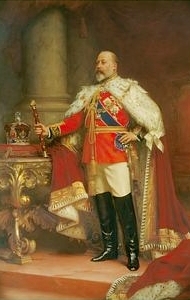
King Edward VII - Coronation-1902. |
|
| Princess
Alexandra of Denmark and eldest daughter of King Christian
IX married Prince of Wales 1863 (1841-1910) and later
King Edward VII and Queen Alexandra of the United Kingdom.
Princess Alexandra was Princess of Wales from 1863 to
1901. From 1910, until her death, she was the Queen Mother,
being a queen and the mother of the reigning monarch George
V of the United Kingdom. Queen Alexandra lived her last
years in Denmark with her sister Empress Dagmar of Russia. |
-
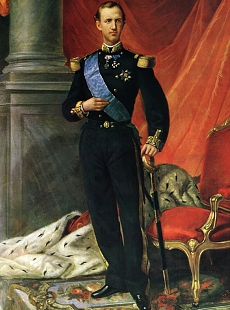
Prince Vilhelm of Denmark (1845-1913 –
ruled 1863-1913) - later King George I of Greece.
Married to Olga Konstantinova, Grand Duchess of Russia.
King
George I of Greece - 1864 |
|
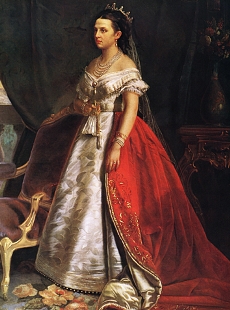
Queen
Olga of Greece -1864 |
|
| Prince
Vilhelm of Denmark was the second son of King Christian
IX and elected King of the Hellenes in 1863, ascending
the royal throne before his father as King George I of
Greece. In 1867 he married Grand Duchess of Russia Olga
Konstantinovna and together they had eight children. King
George I reign for 50 years and was a genuinely popular
monarch together with Queen Olga. |
-
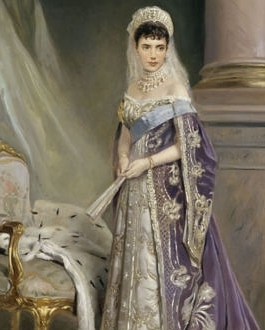
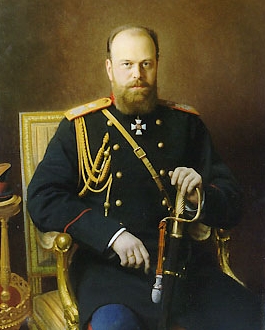
Princess Dagmar of Denmark (1847-1928) -
later the consort of Tsar Alexander III of Russia.
|
|
|
Tsar
Alexander III of Russia |
|
| Princess
Dagmar of Denmark was the second daughter of King Christian
IX and after her marriage to Tsar Alexander III of Russia
in 1866 she became the Empress Consort of Russia as Maria
Feodorovna. Among her children was the last Russian monarch
Tsar Nicholas II, whom she outlived by ten years after
he and his family was executed in 1918 by the Bolsheviks.
Empress Dagmar lived in Denmark the last year of her life
together with her sister Queen Alexandra of the United
Kingdom. Tsar Alexander III and Maria Feodorovna had four
sons and two daughters. |
-
Princess Thyra of Denmark (1853-1933) later the consort
of Ernst August of Hanover, 3rd Duke of Cumberland.
Princess
Thyra of Denmark |
|
Ernst August of Hanover - Duke of Cumberland |
|
| Princess
Thyra of Denmark was the youngest daughter of King Christian
IX and married in 1878 Ernst August of Hanover - 3rd Duke
of Cumberland in Copenhagen. Princess Thyra became the
Duchess of Cumberland and had six children with the Duke.
Thyra was very close connected to her older sisters Queen
Consort Alexandra and Empress Maria Fyodorovna of Russia. |
-
Prince Valdemar of Denmark, (1858-1939). Married
Princess Marie de Orleáns-Bourbon from the House of Bourbon
– France.
| |

| Prince
Valdemar of Denmark was the youngest son of King
Christian IX. He married Princess Marie d'Orleans
in 1880 and had five children. Valdemar had a lifelong
naval career and was offered two European thrones
those of Bulgaria and Norway, but declined them
due to international circumstances. Prince Valdemar
was the last Royal person, who lived in The Yellow
Palace until his death in 1939. |
|
|
Grandparents of Europe With
the great dynastical achievement of the six children, King
Christian IX and Queen Louise was
given the title “Grandparents of Europe”
and a imperial influence throughout the European continent.
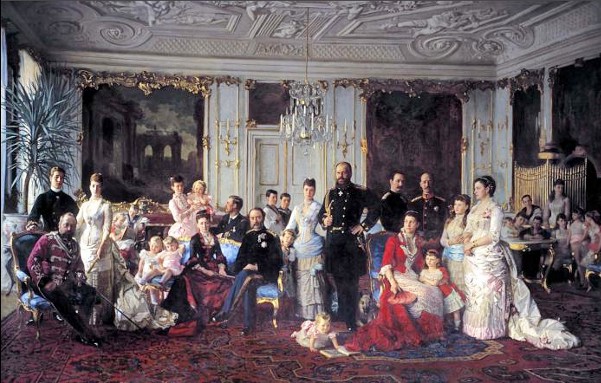
| Famous
painting from 1883 by Laurits Tuxen with King
Christian IX and Queen Louise and the Royal Family
in the Garden Room at Fredensborg Palace together
with all the heads of royalties from European
Royal and Princely houses. During King Christian
IX's long reign, the palace enjoyed a new golden
age with the so-called Fredensborg days, when
Europe's monarchs would gather to spend their
holidays. The huge group painting can be seen
at Christiansborg palace. |
|
The
Yellow Palace is a piece of Danish history
about a building that housed a poor anonymous German Prince,
who was not heir to the Danish throne, but became a national
icon as a Danish King, with an supportive wife with
dynastical ambitions and a outstanding loving
family with a high social intelligence that most of Europe's
reigning and ex-reigning royal families are direct descendants
of.
Denmark
is the oldest kingdom in the world and our currently reigning
monarch Queen Margrethe II, has ancestral
links stretching back more than 1,000 years.
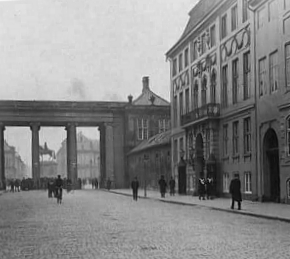
Location
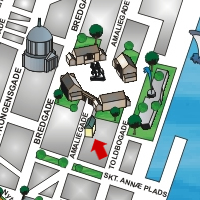
The Yellow Palace is located beside Amalienborg Palace
and the Colonnade on Amaliegade. The property is
used by the Royal Household and the Lord Chamberlain’s
Office. The former Yellow Palace is not open for visitors.
The
Yellow Palace
Address
The
Yellow Palace
The Lord Chamberlain’s Office
Amaliegade 18
1256 Copenhagen K
Busses:
26 |
|
|