Amalienborg
Palaces
- 1750 -1758. |
|
Amalienborg
Palace
The
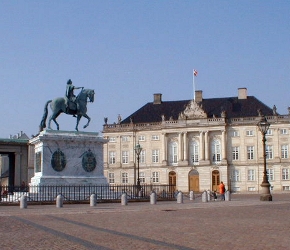
Amalienborg Palace Complex consists of four
rococo palaces from 1750-1758
- and is the prime residence of the Danish Royal family.
The
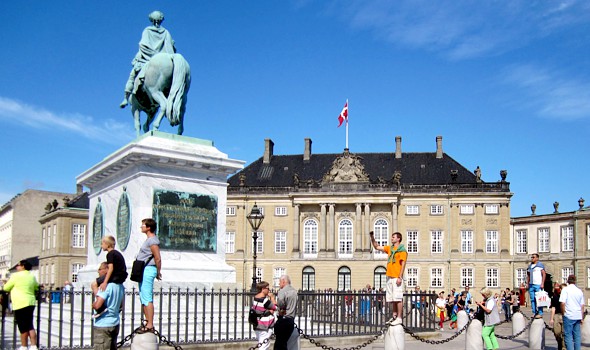
palace buildings are placed around an octagonal
square with a equestrian statue of King
Frederik V (1723-1766 - ruled Denmark and Norway
1746-1766) in the centre - who was the planner and builder
of Frederiksstad in 1748 - where the
Amalienborg palaces area part of.
Brief history of Amalienborg
The land around Amalienborg Palaces was acquired about
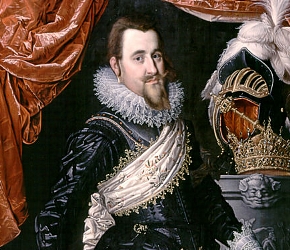
1602 by King Christian IV
(1577-1648 - ruled Denmark and Norway 1588-1648) and
was located outside the ramparts of Copenhagen. King
Christian IV - who was also known as the great architect
and builder of Copenhagen used other parts of the obtained
land to expand the city by building Rosenborg
Castle (1606-24) – Nyboder quarters
- and residence for the royal navy (1631-41) - The
Citadel - a fortification to protect the city
against attacks from the Sound (1624). |
|
King
Christian IV
was also Called the
Great Builder of
Copenhagen
King Christian IV
Acquired the
land for building
The Amalienborg
Palaces
|
|
|
It
was King Christian IV, who acquired the land in 1602
- which was later used for building the future Amalienborg
Palaces. The King's plan was to spread out the city
outside the ramparts of Copenhagen with many of his
other impressive building projects like Rosenborg Castle
- Nyboder Quarters and the Citadel at the Sound. |
|
|
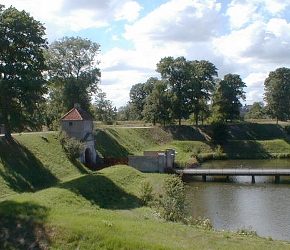
The Citadel from 1624 was one of the larger projects
of King Christian IV - and established on the land he
had obtain in 1602 to develop the city. The Citadel
was built to secure the Northern entrance to the harbour
of Copenhagen and was placed towards the Sound. The
Citadel and old fortress is open for visitors all year
round. |
|
The
first Sophie Amalienborg
The first palace on the area at the waterfront, where the
present Amalienborg palace is placed was called Sophie
Amalienborg and built between 1669-1673
by Queen Sophie Amalie (1628-1685) - who
was consort to King Frederik III (1609-1670
- ruled Denmark and Norway 1648-1670). Sophie Amalienborg
palace was raised by a fire in 1689 and burnt
down to the ground with many casualties. The Queen died in
1685 at Sophie Amalienborg palace - and just
a few years before her castle was demolished. |
|
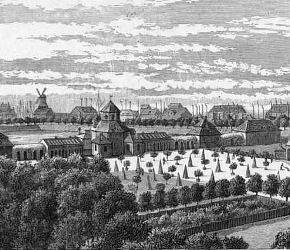
The
first palace on the grounds where the present Amalienborg
Palaces are situated was Sophie Amalienborg from 1669
built by Queen Sophie Amalie. The palace burnt down
to the ground in 1689 and the painting is from 1740. |
|
|
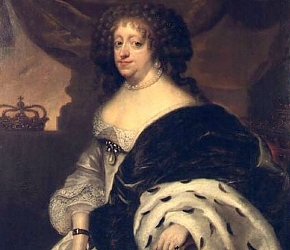
Painting
of Queen Sophie Amalie around 1678 by Abraham Wuchters.
The Queen was consort of King Frederik III - who introduced
the absolute monarchy in 1660. She lived at Sophie Amalienborg
Palace for 15 years after she was widowed. |
|
|
The First
Amalienborg
Palace
was called
Sophie Amalienborg
and
burnt down
in 1689
|
|
The
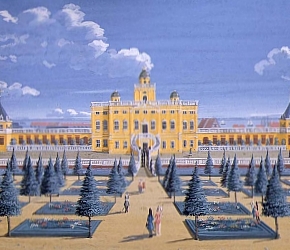
second Sophie Amalienborg
The second royal estate on the Amalienborg premises was built
by King Frederik IV (1671-1730 - ruled Denmark
and Norway 1699-1730) at the beginning of his reign. It was
a small modest summer residence for the royal family in two
stories with a view over the harbor area and surrounded by
a French-style garden. The summer residence was also called
Sophie Amalienborg and later excavated to
give place for the ambitious - and impressive plans of King
Frederik V (1723-1766 - ruled Denmark and Norway
1746-1766) to establish a fashionable district outside the
city walls of Copenhagen. |
|
King
Frederik V and Frederiksstad |
|
King
Frederik V
demolished
the second
Sophie Amalienborg
and created
the fashionable
Frederiksstad
Estate Area
|
|
|
The
Second Sophie Amalienborg |
The
second Sophie Amalienborg was built by King Frederik
IV in 1672 on the same premises as the first Sophie
Amalienborg. The property was a small modest summer
residence surrounded by a French-style garden with a
central pavilion and arcades on both sides. |
|
King
Frederik V was the grand architect behind the new suburban
area called Frederiksstad and the founder of the Amalienborg
complex. The plan was to establish a fashionable district
and homes for nobilities. The portrait is painted by
Carl Gustav Pilo in 1751. |
|
| King
Frederik V and Frederiksstad
King Frederik V selected the grounds of the two former
royal Amalienborg estates to be the centre of his new building
project, which was a prominent district - called Frederiksstad
(Frederik’s City) in Baroque style and mainly
with exclusive homes for aristocrats and noble families. Later
the construction of buildings was created in rococo architecture
and supplanted by the neoclassic style. The new district Frederiksstad
was also built by the King to commemorate in 1748
the tercentenary of the Oldenburg dynasties
ascent to the Danish throne and in 1749 to
celebrate the tercentenary of the coronation of the first
Oldenburg King Christian I (1426-1481) -
ruled Sweden 1457-1464 and Denmark and Norway 1448-1481).
|
|
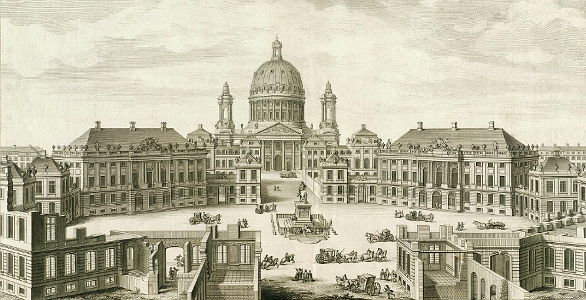
The
new exclusive district called Frederiksstad |
King
Frederik V was the planner of a new exclusive district
called Frederiksstad, with the impressive Marble Church
as a prestigious landmark and the four Amalienborg Palaces
to be the centre point of the fashionable town quarters.
Frederiksstad was built on the former grounds of two
other palaces named Sophie Amalienborg, and the new
suburban area for nobilities was developed by the King’s
leading court architect Nicolai Eigtved. The new district
Frederiksstad was also built as a prominent monument
by the King to commemorate the tercentenary in 1748
of the Oldenburg dynasties ascent to the Danish throne
as well as to celebrate in 1749 the tercentenary of
the coronation of the first Oldenburg King Christian
I. The illustration is from 1756 showing the entire
Frederiksstad complex and Amalienborg Palaces. |
|
Frederiksstad
and the axis
According
to the master plans for Frederiksstad developed by the King’s
leading court architect Nicolai Eigtved -
the major project was composed of four mansions to house four
distinguished families of nobility from the royal circles.
The building plots by the harbour were donated by the King
to the chosen families - and the only conditions were that
the stately manors should be identically built and
placed around the octagonal square that was
a part of the so called Frederiksstad axis - which went through
the Amalienborg complex and quarters. The short axis went
from the Marble Church (Frederikskirke) through
Frederiksgade (Frederiks Street) - and passed the Amalienborg
complex - with the axis line ending at the newly built Opera
house. The Long axis was drawn alongside Amaliegade
(Amalie Street) - and via the octagonal square through
the colonnade that connects two palaces and
further on Amaliegade. The Marble Church was the prime monument
stating the 300 year jubilee of the Oldenborg
line of Royalties. |
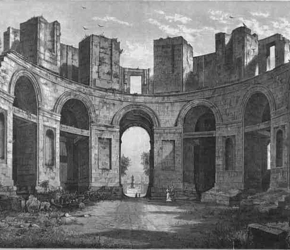
The
foundation stone of the Marble Church was laid by King
Frederik V in 1749 - but due to many budget cuts the
construction was slowed down chiefly as financial resources
were limited. The monumental church was left incomplete
and stood as a ruin for nearly 150 years - as illustrated
here in 1868. |
|
The
Marble Church was completed and inaugurated in 1894
- after 150 years and financed by industrialist Carl
Frederik Tietgen. The Church has the largest dome in
north Europe with a span of 31m. The dome rests on 12
columns and the inspiration of the church design was
probably the Pantheon in Rome. |
|
|
The
Marble Church -
has the highest
Dome in
Northern Europe
|
|
The
building of the palaces starts in 1750
The
building of the four palaces started in 1750
and in 1754 the two first rococo buildings
called Moltke's Palace and Levetzau's
Palace were completed at the west end of the Amalienborg
compound. After completion and in the same year the court
architect Nicolai Eigtved died and was replaced by his colleague
Lauritz de Thurah, who continued the work and finished
the two projected palaces in 1760 named Brockdorff's
Palace and Schack's Palace. The
most expensive of the four new palaces was Moltke’s
Palace (later King Christian VII's Palace) - presenting the
most extravagant interiors.
Memorial Plate
A memorial plate for the court architect
Nicolai Eigtved - who worked out the plan of Frederiksstad
is placed on the wall of King Christians VIII's Palace
on Frederiksgade.
|
|
The Four Palaces
was and has
always been
a great
outing venue
for
Copenhageners
|
|
|
Amalienborg
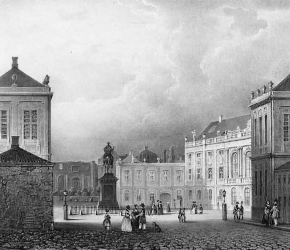
Palaces in 1843 |
The
Amalienborg Palaces in 1843 - seen from the north-eastern
end with the equestrian statue of King Frederik V- and
glimpse of the uncompleted Marble Church in the back.
The Amalienborg square was a popular outing place for
Copenhageners - and at that time the reigning King was
Christian VIII - who resided in Levetzau's Palace (the
visible palace to the right - beside the Marble Church
- and later named Christian VIII's Palace. |
|
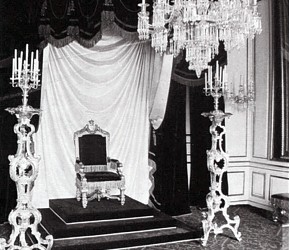
The
Throne Room in Christian VIII's Palace from 1802 created
by Nicolai A. Abildgaard. Actually - King Christian
VIII - who gave name to the palace - was the last Danish
Monarch to be anointed and crowned as King in 1839,
as the coronation ceremony was abolished after he had
succeeded the throne. The Crown Jewels and the Danish
Crown Regalia are kept safely at Rosenborg castle and
are displayed for the public. |
|
The
equestrian statue
The
Owner of Moltke’s Palace and head of the Danish Asiatic
Company as well as Lord High Steward A. G. Moltke
commissioned the equestrian statue of the
founder of Frederiksstad and the Amalienborg palaces King
Frederik V, which is placed in the centre of the
octagonal square. The French sculptor Jacques-Francois-Joseph
Saly was given the task in 1753,
and the equestrian statue was completed and finally unveiled
in 1771 - unfortunately - the King died in
1766 after only 43 years of life and 20 years
of reign - 5 years before the equestrian statue of him was
inaugurated. Thanks to a great donation from the A.P.
Møller and Chastine McKinney Møller Foundation
the statue was restored in 1998 - and brought
back to its original glory. |
|
The
Equestrian Statue of King Frederik V |
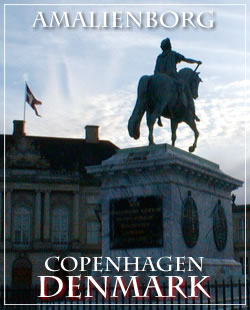
The
equestrian statue of King Frederik V placed in the centre
of the octagonal square at Amalienborg. The French sculptor
Jacques-Francois-Joseph Saly took nearly 12 years to
create the monument and the statue was finally unveiled
in 1771. |
|
The
colonnade between Christian IX's Palace and Christian
VII's Palace was erected in 1795 to connect the royal
families. The
eight Ionic columns are constructed of solid painted
wood and designed by the royal architect Caspar Frederik
Harsdorff. |
|
|
The
equestrian statue
of
King Frederik V
presents
the King as a
Roman Emperor
The
Colonnade is
made of
solid painted
Wood
|
|
The
Colonnade
The
colonnade between the newly occupied estates Moltke’s
Palace -residence of King Christian VII and Schack’s
Palace - residence of the Crown Prince was designed by the
royal architect Caspar Frederik Harsdorff
and erected in 1794-1795 to connect the royal
families and their residences. The eight Ionic columns are
constructed of solid painted wood and formed as pilasters
in ancient Greek architecture. |
|
The
Royal Family moves to Amalienborg in 1794 |
Christiansborg
Palace and Amalienborg Palace
In 1794 the royal residence Christiansborg
Palace was raised by heavy fires and the reigning King
Christian VII (1749-1808) - ruled Denmark and Norway
1766-1808) and his family became homeless - which made the King
acquired the two empty Amalienborg estates - Moltke’s
and Schack’s Palaces. The royal family moved
into the palaces within a few days after the catastrophe at
Christiansborg. |
|
Christiansborg
Palace
and
Amalienborg Palace
was
Royal residences
in 1794
|
|
|
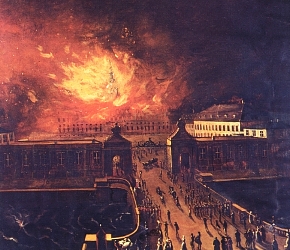
Christiansborg
Palace on fire in 1794 |
The
first Christiansborg Palace from 1745 was the Royal
residence in Copenhagen and was destroyed by a fire
in 1794 - while King Christian VII resided in the palace.
The Royal family became homeless and moved for the first
time to the private Amalienborg mansions - which were
fortunately unoccupied and ready to move into. |
|
|
Amalienborg
- Royal residence in 1794 |
| The
first mansion that was acquired as a Royal residence
by King Christian VII in 1794 - was Moltke's Palace
- later renamed as Christian VII's Palace. The palace
beside called Schack's Palace became the residence of
Crown Prince Frederik (6) - and was connected by a long
colonnade of wood in 1795. |
|
Four
official Royal Residences
From
the date that the King achieved the first two Amalienborg
palaces in 1794, and later when the two other
palaces became permanent residences for royal families - the
four mansions changed names and status as royal palaces, and
over the years various Kings and Queens with their families
have resided in the four different palaces. It is a tradition
that each palace ranks on shift as official royal
residences - when a reigning monarch resides in the
preferred palace. |
|
Moltke’s
Palace and King Christian VII’s Palace |
Moltke’s
Palace and King Christian VII’s Palace
Moltke’s
Palace nearest the Marble Church, changed name to King Christian
VII’s Palace and was the first palace that was assigned
for the royal family. Since then and after the death of King
Christian VII - Christian VII’s Palace – named
after the King - was used for the Royal Household
and later in 1852-1885 as administration
building for The Ministry of Foreign Affairs.
Since 1885 Christian VII’s Palace is
used to accommodate prominent guests and for royal receptions
and ceremonial purposes. King Frederik VII is the only monarch,
who has lived in the palace permanently. For a short time
Crown Price Frederik (IX) and Crown Princess Ingrid lived
in the palace - as well as their daughter Crown Princess Margrethe
(Queen Margrethe II) and her late husband Prince Henrik.
Both
the exterior and interior at King Christian VII’s
Palace was restored 1982 - and the palace
and state rooms are open for visitors on
a regular basis in the summer season. |
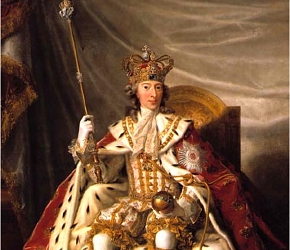
King
Christian VII was the first monarch, who resided at
the Amalienborg complex in Moltke’s Palace later
called Christian VII’s Palace. The King is here
portrayed in 1789 by Jens Juel in his coronation robes
together with the Crown Jewels and Regalia. The King
is wearing the Crown of the Absolute Monarchs created
by Paul Kurtz in 1670 for King Christian V and later
used by the following Kings up to Christian VIII. The
Crown is still in use - on the catafalque of a deceased
sovereign. |
|
|
King
Christian VII's Palace |
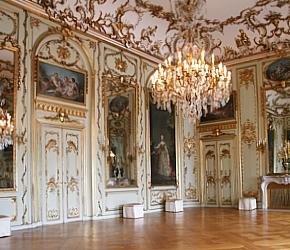
The
Knights Hall or Great Hall at Christian VII's Palace
from 1754 is one of the most decorated and lavishing
rooms of the four Amalienborg palaces. This palace was
the most expensive at the time it was built - and had
the most extravagant interiors and was furnished with
the greatest magnificence in the finest Rococo style.
Since 1885 the property has been used for royal receptions
- and to entertain and accommodate prominent guests
as well as foreign heads of states. |
|
|
King Christian VII's
Palace
was the most
expensive
Estate to build
and
had the most
Extravagant
Interiors and
Furniture
in Rococo Style -
when inaugurated
in 1754
|
|
|
Schack's
Palace and King Christian IX's Palace |
|
Schack's
Palace and Christian IX's Palace
Schack’s
Palace changed name to Christian IX’s Palace and located
near the waterfront and Amalie Garden. The
Palace was the second palace acquired by King Christian VII
after the fires of Christiansborg Palace. The Crown Prince
and later King Frederik VI (1768-1839) -
ruled Denmark 1808-1839 and Norway 1808-1814) was resident
here, and after his death in 1839 the Supreme Court and the
Ministry of Foreign Affairs used the royal premises. The former
monarch and Regent King Christian IX (1818-1906)
– ruled Denmark 1863-1906) entitled "Europe’s
father-in-law" - and his Queen Louise moved
from the Yellow Palace - just a few blocks away - into the
palace in 1863. King Christian IX is the
first Monarch of the Glücksborg line and the palace is
named after the King. Finally and since 1967
- King Christian IX’s Palace has been the royal residence
for the present reigning monarch Queen Margrethe II
of Denmark and the late Prince Consort Henrik.
King Christian IX’s Palace is not open for visitors. |
|
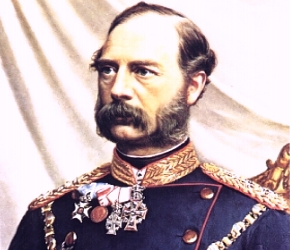
King Christian IX
was the first
Monarch
from the
Glücksborg
Dynasty
to reside at
Amalienborg
|
|
|
King
Frederik VI and Frederiksberg Castle |
| Crown
Prince Frederik - later King Frederik VI and his family
in 1821 - was the first Royal family - who move into
Schack's Palace in 1794 - later named Christian IX's
Palace - after the fires had raised their home at Christiansborg
Castle. The Kings favourite residence was Frederiksberg
Castle located 3 km outside of Copenhagen - where his
consort Queen Marie died in 1852. Since 1967 - King
Christian IX's Palace
has been the royal residence of Queen Margrethe II and
the late Prince Consort Henrik. |
|
|
King
Christian IX - "Europe’s
father-in-law" |
|
King
Christian IX (picture) moved from the Yellow Palace
beside Amalienborg to Schack's Palace in 1863 with his
consort - Queen Louise and family. The Schack's palace
was renamed after him - as King
Christian IX's Palace.
The King is the first monarch of the later Glücksborg
Dynasty and was titled "Europe’s
father-in-law"
- as four of his children became monarchs and one grandchild
King of Norway. Most of Europe's reigning and ex-reigning
royal families are direct descendants of King Christian
IX and Queen Louise. |
|
|
Royal
residence - and a historic building from 1764. |
|
The
Yellow Palace - and the Glücksborg Dynasty
The
Yellow Palace (Det Gule Palæ)
is an interesting historic building from 1764
- in Louis Seize style - and designed by the
French architect Nicolas Henri Jardin for the merchant
H.F. Bargum. Since then - The Yellow Palace became the
Royal residence for the first Glücksborg
family in 1837 - namely by Prince Christian
of Glücksborg - and Princess Louise of Hessen that
one day would rule the Danish Kingdom - and be the King
and Queen of Denmark - as King Christian IX
and Queen Louise. |
|
|
Brockdorff's
Palace and King Frederik VIII's Palace |
|
Brockdorff's
Palace and Frederik VIII's Palace
Brockdorff's Palace changed name to Frederik VIII's Palace
and situated in the northeastern end of the square and near
the Amalie Garden and harbor area. The palace was acquired
by King Frederik V in 1765
- and in 1767 the palace housed the Military
Academy also called the Army Cadet Academy (Landkadetakademi).
The Naval Cadets took over the property in 1788 and
in 1827 the Military Academy was closed,
when King Frederik VI decided that his daughter
princess Vilhelmine and Crown Prince Frederik - later King
Frederik VII – the last Oldenborg King
and the first constitutional Danish monarch (1808-1863
- King of Denmark 1848-1863) should reside at Frederik VIII's
Palace after their wedding - and after a completely restoration
of the royal estate had been accomplished. In 1869
Crown Prince Frederik - later King Frederik VIII
(1843–1912 - King 1906-1912) moved into the palace,
which was named after the King. In 1934 Frederik VIII's Palace
became the home for Crown Prince Frederik and Crown Princess
Ingrid and later the royal residence - when the Crown Prince
succeeded the throne as King Frederik IX (1899–1972
- King 1947-1972). The admired Dowager Queen Ingrid
lived here until her death in 2000. Since,
Frederik VIII's Palace has
undergone a total renovation and face lift, and the residence
for the next generation of royalties - Crown Prince
Frederik, Crown Princess Mary and family. |
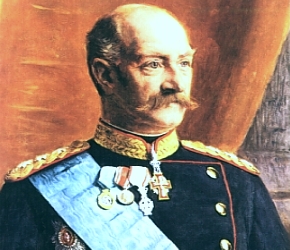
Brockdorff's
Palace was one of the first Amalienborg palaces - which
was acquired in 1765 by King Frederik VI - and later
used to house the Military Academy. Several members
of the Royal family live in the palace until Crown Prince
Frederik moved in with his family in 1869. When the
Crown Prince became King Frederik VIII in 1906 (picture),
and second Glücksborg monarch on the Danish Throne
- the palace was renamed after him. |
|
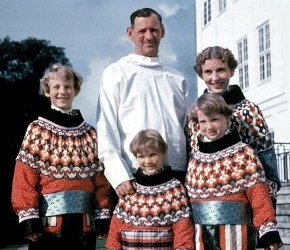
King
Frederik IX with his consort, Queen Ingrid and the princesses
Margrethe (Queen Margrethe II), Anne-Marie (Queen Anne-Marie
of Greece) and HRH Benedikte in 1952 all dressed in
national costumes from Greenland. King Frederik IX lived
in Frederik VIII's Palace from 1934 until his death
in 1972, and the Dowager Queen Ingrid lived here until
her death in 2000. King Frederik IX was the fourth Glücksborg
monarch on the Danish throne. |
|
|
Only Kings named
Frederik has
resided in
King Frederik VIII's
Palace -
and the future
King Frederik X
reside in the palace
today
|
|
Restoration
of King Frederik VIII's Palace for DKK 130 Million
After the renovation of King Frederik VIII’s palace
for over DKK 130 million in 2010 - the Crown
Prince Couple invited everybody to experience the
renovated and redecorate palace - and since - nearly a half
million visitors has seen a modern home with new
fine art that is custom-made especially for the new modernize
palace - as well as the restoration of the indoor architecture.
The new generation of royalties has entered a top modern estate
in historical surroundings - as their new winter residence. |
|
A new generation
in
King Frederik VIII's Palace
|
|
|
Amalienborg
Palace & Amalie Garden |
|
The
Crown Prince Couple and family moved into King Frederik
VIII’s Palace in 2010 - and their new home at
this Amalienborg Palace is right beside Copenhagen's
waterfront and the Amalie Garden. |
|
|
Amalienborg
Palace & King Frederik VIII's Palace |
|
After
the renovation of King Frederik VIII’s Palace
- nearly a half million visitors - invited by the Crown
Prince Couple - experienced the refurbished royal premises
at this Amalienborg Palace. |
|
|
A
new generation in King Frederik VIII's Palace
The Crown Prince Couple and family did receive the key to
King Frederik VIII’s Palace at Amalienborg
in October 2010 - and have moved into their
new home. The Royal split flag will once
again rise over the palace building - that is the only palace
in the Amalienborg complex with a clock on
the fronton of the building. |
|
From
2024 - King Frederik VIII's Palace is the present
Royal residence of the reigning monarch King Frederik
X and his consort Queen Mary, Crown
Prince Christian and his Royal siblings. |
| King
Frederik VIII's Palace is not open for visitors. |
|
Levetzau's
Palace and King Christian VIII's Palace |
Levetzau's
Palace and Christian VIII's Palace
Levetzau’s
Palace changed name to Christian VIII's Palace and is situated
at the northwestern end of the octagonal square and near the
Marble Church. The Palace was bought by the Heir Presumptive
Frederik in 1794, who had it modernised
in new French Empire style and used it as his residence until
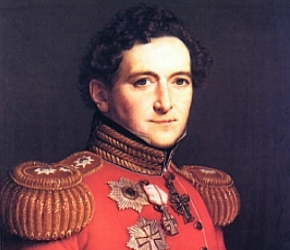
he died in 1805. The Crown Prince Christian,
who grew up in this palace - and later crowned as King
Christian VIII (1786-1848 - King 1839-1848) - and
gave name to the palace. After King Christian VIII died in
1848 and Dowager in 1881
- the Ministry for Foreign Affairs used the premises until
1898. Then the palace was selected as residence
for Crown Prince Christian (X) and Crown
Princess Alexandrine - the later King Christian
X (1870-1947 - King 1912-1947). After the death of
King Christian X - the palace was disposal for his son and
Heir Presumptive Knud. The Palace went through a complete
refurbishment in the 1980s and was the home
and state rooms of the present heir to the throne Crown Prince
Frederik. |
King
Christian VIII (picture) grew up in Levetzau's Palace,
which was bought by his father the Heir Presumptive
Frederik in 1794. When crowned as King in 1839 the palace
was renamed Christian VIII's Palace. The King was the
last Danish monarch to be crowned, as the coronation
ceremony was abolished after he had succeeded the throne.
King Christian VIII started the process of given Denmark
a free constitution, which was fulfilled by his son
and last Oldenborg monarch King Frederik VII in 1849. |
|
Crown
Prince Christian (X) and Crown Princess Alexandrine
moved into Christian VIII's palace in 1898 after their
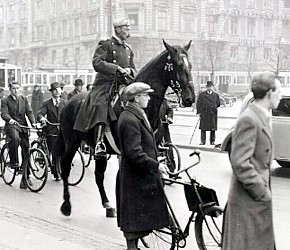
wedding. The later King Christian X lived in this palace
with his consort Queen Alexandrine until his death in
1947. During the German occupation of Denmark the King
took a daily ride on horseback through his city and
won much admiration and sympathy among the Danes. King
Christian X was the third Glücksborg monarch on
the Danish throne - and was also known for his impressive
199 cm height. |
|
A part of
King Christian VIII's
Palace
Houses the
Amalienborg Museum
displaying the
history of the Glücksborg Dynasty
|
|
King
Christian X - and the Nazi occupation
There
are several legends about King Christian X during the Nazi
occupation of Denmark - 1940-1945.
Greetings from Adolf Hitler
In 1942 - Adolf Hitler sent King
Christian X a very long telegram congratulating him
on his 72th birthday. King Christian X’s
reply telegram was very simple with the few words - "Meinen
besten Dank". Chr. Rex (My best thanks
- King Chr.). This disrespectful message outraged Hitler and
he immediately recalled his ambassador from Copenhagen and
expelled the Danish ambassador from Germany.
The
Danish Flag at Amalienborg Palace
Another popular legend is the one of the royal flag on the
top of Amalienborg Palace. The Nazis wouldn't
let King Christian X fly the Danish flag
at his palace - and told him that if it wasn't taken down
the Nazis would send a soldier to pull it down. King Christian
X replied - if that was the case he would send a Danish soldier
to raise it again. The Nazis replied that they would shoot
that soldier - and the King replied - "that Danish
soldier will be me". And throughout the war
and 5-years of Nazi occupation
the royal Danish flag flew at Amalienborg. |
Artifacts
and history
representing
The Glücksborg
line of royalties
from 1863 - 1972
|
|
|
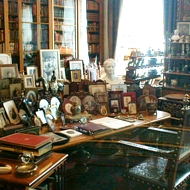
Study
of King Christian IX |
The
office and study of King Christian IX at the Amalienborg
museum. |
|
|
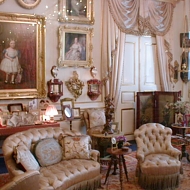
Living
room of Queen
Louise |
Living
room of King Christian IX and Queen Louise at the Amalienborg
museum. |
|
|
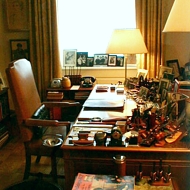
Study
of King Frederik IX |
The
office and study of King Frederik IX at the Amalienborg
museum. |
|
Amalienborg
Museum at King Christian VIII's Palace
King Christian VIII's Palace houses the Amalienborg museum
displaying the history of the Glücksborg Dynasty
and their private royal apartments from 1863-1972
including the original furnishings. The museum is
open for visitors all year round and there are guided tours
to the "Bel-etage" (Gala-Hall)
in King Christian VIII's Palæ on Wednesdays and Sundays. |
| Part
of King Christian VIII's Palace is open for visitors. |
|
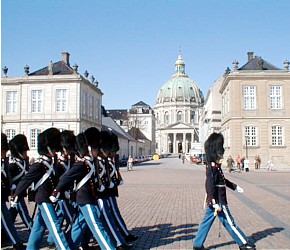
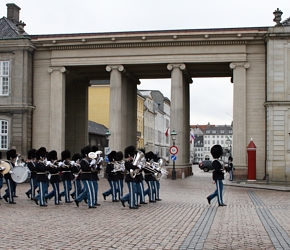
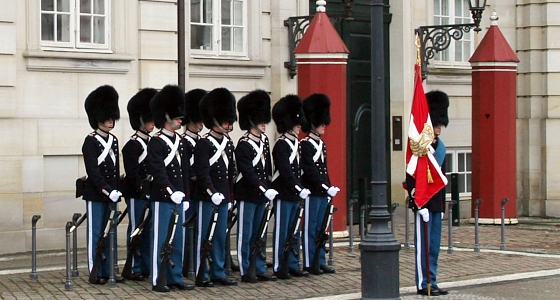
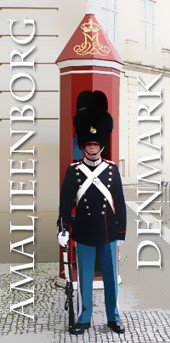
The
Royal Life Guards
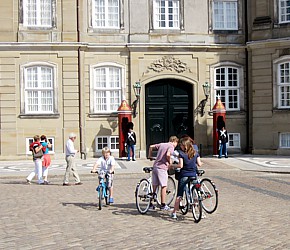
Amalienborg Palace is always guarded day and night all year
round by The Royal Life Guards - as this
special regiment has had the closes connection to the Royal
House since 1658. The brigade was established
by King Frederik III (1609-1670 - ruled Denmark
and Norway 1648-1670) - and the main duty was to protect the
King and the Royal Castles and Palaces as well as being present
during ceremonial occasions and Royal receptions.
Guard Mounting
Changing of the Guard is one of the oldest and most common
of all royal ceremonies - a new guard exchanges duty
with the Old Guard to continue their operational commitments
- and the handover is mainly accompanied by a the Royal
Guards Music Band playing traditional military marches.
See:
Rosenborg Castle
|
|
The Royal Life Guards
have protected
Danish Kings and
Queens plus the Royal
Palaces and Castles
Since 1658
|
|
|
The Royal Life Guards - Amalienborg Palace |
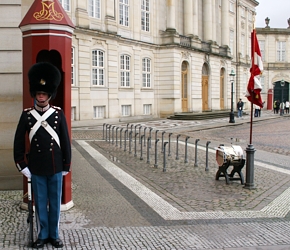
Kongevagt
- The Kings Guard - is exercised when the King and
Queen is in residence. After changing of the Guards
the ceremonial act continues by leaving the drum and
regents flag on the drill ground in the day time -
to announce that the King and Queen is in residence.
|
|
The
practice and parade of the Royal Danish Life Guards
|
|
Amalienborg
- Royal Guards |
| The
Royal Life Guards - Founded in 1658. Amalienborg Palace. |
|
Kongevagt
- The King’s Guard - is exercised
when the King and Queen is in residence
- and will be accompanied by the Band of the Royal Danish
Life Guards. The guards will departure from Rosenborg
Castle at 11:30 - and end at Amalienborg
palace at 12:00 - where changing of
the guards takes place. After the parade and shift -
the Guards leaves the drum and the
Regents Flag on the drill ground in
the daytime at King Christians VII’s Palace beside
the colonnade.
Løjtnantsvagt
- The Lieutenant Guard - is exercised
when the Crown Prince - as well as
other members of the Royal Family
are reigning - and are in residence at Amalienborg -
in absence of the King and Queen. The
guards will be accompanied by the Band of the Royal
Danish Life Guards and will departure from Rosenborg
Castle at 11:30 and end at Amalienborg
palace at 12:00 - where changing of
the guards takes place. After the parade and shift -
the Guards only leave the drum on the
drill ground in the daytime at Christians VII’s
Palace beside the colonnade.
Palævagt - The Palace Guard -
is exercised when the Crown Prince
or other members of the Royal Family
reside at Amalienborg. The guards will march from Rosenborg
Castle at 11:30 through Copenhagen
without any musical band or accompaniment and end at
Amalienborg palace at 12:00 - where
changing of the guards takes place.
Walking beside The Royal Life Guards
Visitors can follow or walk along with the Royal Life
Guards from Rosenborg Castle through Copenhagen to Amalienborg
Palace and visa versa.
|
|
The
blue uniform from 1848
In connection with ordinary duties for the Royal House
- The Royal Danish Life Guards are dressed in the original
dark blue field uniform from
1848 - with a tall fur bearskin cap from 1805
- which weighs nearly 4 kg. together
with a symbolic Guards sabre and a standard army rifle
M/95. |
|
|
The
dark blue uniform from
1848 |
The
Life Guards blue uniform, while they are on ordinary
guard duty, is dated back to 1848. The drum and flag
indicates that the King and Queen is in residence. |
|
|
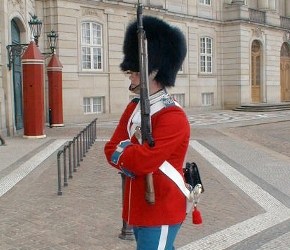
Red
full-dress uniform from 1660 |
On
special occasions and when specific events within
the Royal House are celebrated - the Guards will wear
the red gala uniform - which dates back to about 1660. |
|
|
The Tall Fur
Bearskin Cap
weighs 4 Kg -
and if the
temperature
reaches over
+ 30° C
the fur cap
is replaced
by a smaller
and more
cooler and
comfortable
Garrison Cap
|
|
The
red full dress uniform from 1660
On special occasions and other ceremonial matters within the
Royal House - the Royal Danish Life Guards will wear the
red full-dress uniform dated back to about 1660.
Visitors at Amalienborg Palace will experience the Royal Danish
Life Guards in their rich coloured red full-dress uniform
- when birthdays - weddings - birth - christening
- anniversaries etc. are celebrated within the Royal
House and by the Royal family members involved.
|
When
the King and Queen and other members of the royal family are
in residence in any of the palaces the swallow-tailed
Danish flag (Dannebrog) will be flying over
the palace concerned. The Kings flag has
the royal coat of arms in the central field and special versions
of the Royal swallow-tailed flag with different monograms
represent each family member of the Royal House. |
|
The Danish Flag
"Dannebrog"
fell down
from the
sky in 1219
in Estonia
|
|
|
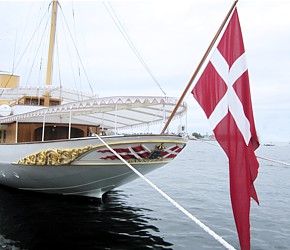
The
Royal Yacht Dannebrog from
1931 |
The
Royal Yacht Dannebrog has been the official and private
residence of Danish monarchs and the Royal House since
1931. Since, the yacht has travelled over 300,000
nautical miles - mainly visiting ports in Denmark,
Greenland and the Faroe Islands. The swallow-tailed
Danish flag (Dannebrog) is flying, when the Royal
family is residing on board. |
|
|
The
Danish flag from 1219 |
According
to the myth - the Danish flag fell down from the sky
in June 1219 in Estonia. With the flag in his hand,
King Valdemar II won the battle at Lydanise near Tallinn.
The painting of the event is illustrated by Christian
A. Lorentzen in 1809 - and displayed at The Danish
National Gallery. The legend of the flag is very popular
among Danes. |
|
The
National Danish flag - Dannebrog
The national Danish flag (Dannebrog) is the oldest national
flag in the world dating back to the 14th century.
According to the myth the Danish flag fell down from the sky
in June 1219 as a revelation for the Danish
King Valdemar II - called Valdemar the Victorious
(1170-1241 - King 1202-1241) during his crusade to Estonia
- and with the flag in his hand - King Valdemar II won the
battle at Lydanise near Tallinn. The King
commanded the historic flag to be the Danish National flag.
The legend of the flag is very popular among Danes.
The Danish flag (Dannebrog) was once the flag of Norway
too - during the Danish-Norwegian Union until 1821.
Norway acquired their own National flag by putting a blue
stripe in the white cross - when
they became an independent nation. The design of the Danish
flag with the Christian cross was also later
adopted by the other Nordic countries like Sweden
- Finland - Iceland and the
Faeroe Islands. |
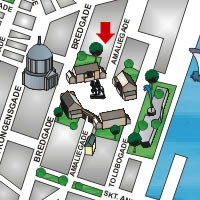
Location
Amalienborg Palace is located near the Marble Church
- Amalie Garden - The Yellow Palace
- The Royal Playhouse and opposite the Opera
House alongside the waterfront. |
Amalienborg
Slot - Amalienborg Palace
Address
Amalienborg Palaces
1257 Copenhagen K
King Christian VIII's Palace:
Amalienborg Museum - Private apartments of the Glückborg
Kings from 1863-1972.
King Christian VII's Palace:
Quarters for foreign heads of state.
Guided tours in July and September.
|
|
|