|
The Palace Chapel
After
the fires of the first Chapel at Christiansborg Palace - the
present Chapel was built as a parish church for the Royal
Family and inaugurated in 1826 by a ceremony
to commemorate the 1000 year anniversary
of the Danish Kingdom adopting Christianity
and the Christianization of Denmark
During
the ruling of King Christian VI (1699-1746
– ruled Denmark and Norway from 1730-1746) the first
Palace Chapel was built in the period 1732-1745,
with an eminent Rococo style interior. In 1794 the
first Christiansborg Palace was destroyed by a heavy fire
and burnt down to the ground, and the Palace Chapel was also
greatly ruined. In 1813 it was decided to
use the existing foundations and the rest of the masonry to
build a new church in connection of the rebuilding of the
second Christiansborg Palace.
| In
1826 the first Palace Chapel was inaugurated as
a parish church for the Royal Family - and a special
memorial service was held to commemorate the 1000
year anniversary of the Christianization of the
Danish Kingdom. |
|
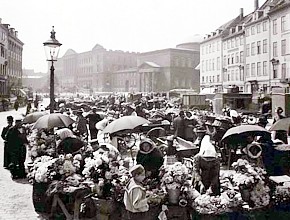
| The
Palace Chapel was spared after the second Christiansborg
palace was destroyed by fires in 1884. The picture
from 1885 shows the market on Amagertorv and the
Palace Chapel with the burnt ruins of Chriatiansborg
Palace in the back. |
|
The
Royal Chapel
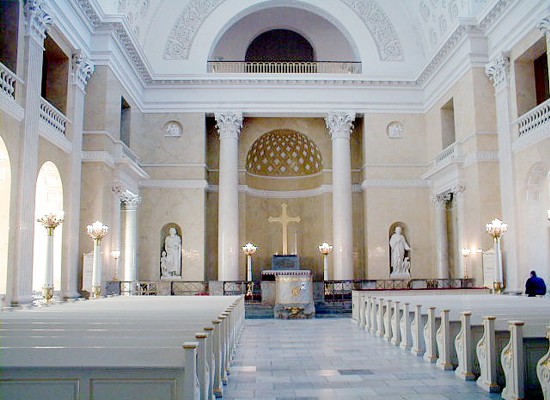
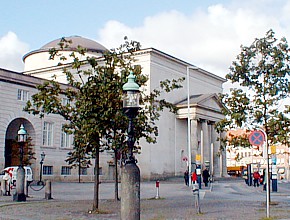
The new Palace Chapel was built in neo-classical style
and completed for services to the members of the Royal Families
and Court in 1826. The first royal ceremony
was the wedding of Prince Frederik (King Frederik VII) in
1828 and since then many royal weddings and
other regal ceremonies have been performed at the Palace Chapel.
When
Danish monarchs die, it is a tradition that the deceased sovereign
lie in state (Castrum Doloris - the name for decorations
accompanying the catafalque that increase the prestige of
the funeral and signify the importance of the deceased) at
the Palace Chapel before they are taken to their final resting
place at Roskilde Cathedral. Latest in 2000,
Queen Ingrid lay in state in the Palace Chapel and
more than 30,000 people passed the Royal
Coffin to pay their last respects to a much admired monarch.
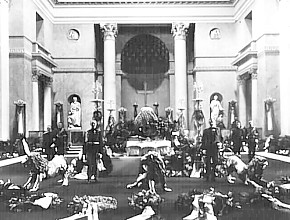
| A

long lasting tradition is that Danish monarchs
lie in state in the Palace Chapel - here is the
catafalque with the coffin of King Frederik VIII
in 1912, surrounded by the silver lions from Rosenborg
Castle. |
|
| The
latest memorial service for a deceased sovereign
was held in 2000, when Queen Ingrid lay in state
at the Palace Chapel. More than 30,000 people
passed the Royal Coffin to pay their last respects
to a much admired monarch. |

|
The
heavy fire in 1992
The Palace Chapel was spared after the second Christiansborg
palace was destroyed by fires in 1884 - but
in 1992 the Palace Chapel was raised by a
heavy fire and burnt the building nearly down to the ground,
probably set by fireworks during the Whitsun Carnival. The
walls and the historical inventory were extremely damaged
together with the roof and dome.
| The
Palace Chapel is also used every year for a special
service by members of the Danish Parliament before
the opening of the Danish Parliament the first
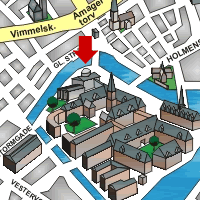
Tuesday of October. The Chapel is located right
beside the Parliament building called "Folketing". |
|
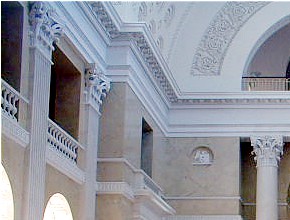
| The
difficult task of recreating the marbled stucco
work after the fire in 1992 was conducted by German
experts, who were skilled to use a special technique,
which was taught to the Danish stucco workforce
during restoration of the Chapel. |
|
Rebuilding
and restoration
The rebuilding and restoration work of the Palace Chapel stated
shortly after the fire and was conducted by German experts,
who brought the neo-classical church building
and interior back to its original state, including the difficult
task of recreating the internal marbled stucco.
Since, the Palace Chapel has been awarded several architectural
prizes for its notable restoration and latest received the
Europa Nostra Architectural Heritage prize.
Location
In connection with the celebration of Queen Margrethe’s
silver jubilee in 1997 the Palace Chapel
was inaugurated with a ceremony for royalties and officials.
|