|
The
Royal Library
The Royal Danish Library was founded by King Frederik
III (1609-1670 - ruled Denmark and Norway 1648-1670)
around 1648 and later in 1673
the library was established in a suitable building - just
opposite Christiansborg Castle (The Danish Parliament). During
1661 and 1664 the King acquired
four private libraries and their book collections formed the
basis of the Royal Library. Peder Schumacher
- later named Griffenfeld - became the King's
librarian in 1663 - and in the following
period he completed together with the King “Kongeloven”
in 1665 (Lex Regis - Royal Law) - the constitution
of the Danish absolute monarchy.
The King's book collection
Peder Schumacher was a learned librarian
- and a widely travelled man - who bought books in Paris
- Amsterdam and Venice - and also
invited French bookbinders to Copenhagen.
The Icelandic manuscripts were acquired in
this period. Many great private book collectors knew the King's
passion for books - and mostly they willed their collections
to the King and to his new Royal Danish Library. The new collections
of valuable literature were added to the library - and when
the founder of the Royal Library King Frederik III
died in 1670 - the collection of books had
reached over 20.000 volumes.
Founder
of the Royal Danish Library King Frederik III
painted in 1663 - had a great passion for collecting
books and acquires several private libraries that
formed the present Royal Danish Library book collection. |
|
|
The
absolute monarchy in 1665 |
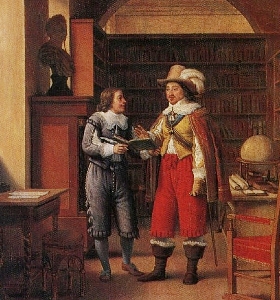
Painting
by C. W. Eckersberg in 1824 of King Frederik III
with Librarian Peder Schumacher named Griffenfeldt,
holding the new (Royal Law ) - constitution of
Danish absolute monarchy in 1665. |
|
Opened
to the public
Slowly the collections were increased during the next century
- mainly by attaining many private collections - and at the
end of the 18th century the library had changed
character and became both a scholarly as
well as a national library.
In 1793 the library was opened to the public
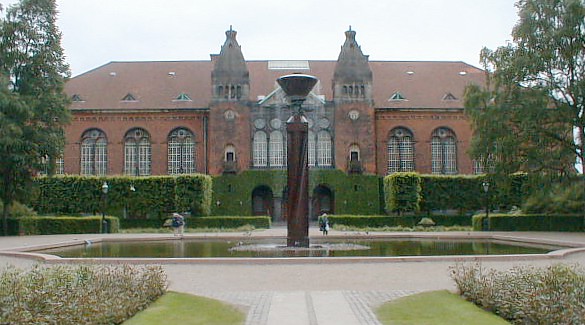
- and in 1906 the present building on the
Isle of Slotsholmen was inaugurated to house
the Royal Library and the National Archives.
Since the 17th century - several arrangements
had ensured that all publications printed in Denmark had to
be delivered to the Royal Library. The new building houses
the first photographic studio in the library world - and the
book stock increases to 800,000 vols during
this period.
The
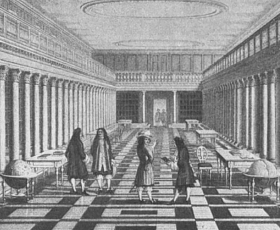
grand hall in 1673 at the Royal Library in new
premises opposite Christiansborg Castle. |
|
|
The
great library hall in 1893 |
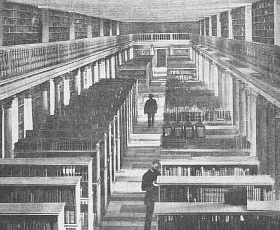 |
The
great library hall in 1893 including King Frederik
IIIs collection from 1670. |
|
The
National Danish Collections
In 1989 - the Royal Library and the University
Library from 1482 merged into one institution
with three locations under the patronage of the Ministry of
Cultural Affairs.
The University Library was stocked with a
very rich book collection and manuscripts - which all were
destroyed throughout the heavy fires of Copenhagen in
1728. With the help of many donations and book contributions
the University Library was quickly re-established and at the
beginning of the 19th century the number
of volumes had increased to more than one million.
The National Danish Collection includes: printed materials
- such as books - journals - newspapers - pamphlets - printed
in the Kingdom of Denmark since 1482 - including
Scania (Sweden) until 1658 - Norway until
1814 - Iceland until 1944
- and the duchies of Schleswig-Holstein until 1864
- as well as Greenland and the Faeroe
Islands.
|
The
oldest printed book in Denmark |
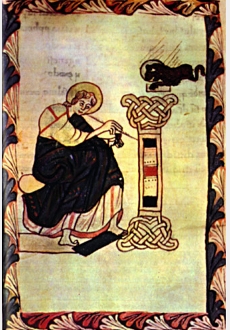 |
The
oldest printed book in Denmark - and in the
Nordic countries - is the Dalby book from 1060
- which was written on parchment paper. The
book belongs to the RoyalDanish Library. |
|
|
The
eldest book from 1275 |
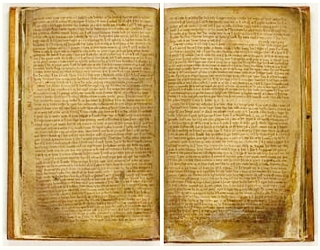 |
The
eldest book at King Frederik IIIs Royal collection
- is the book from Island named Morkinskinna from
1275 - and is still in the position of the Royal
Danish Library. |
|
The
Oldest Danish book
Among the medieval manuscripts from Danish monasteries are
“Dalbybogen” - the oldest evangelical
Christian book in Denmark - and the Nordic countries
from Dalby around year 1060. The book is
written on parchment paper - and is a precious part of the
Royal Library’s collection - describing the Four
Evangelists in writing - and supported with additional
illustrations.
|
Remarkable Danish Composition
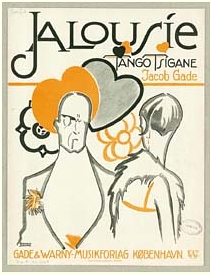
Tango Jalousie composed by Jacob Gade - 1925
One
of the most remarkable music pieces ever composed was
Tango Jalousie - Tango Tsigane.
The
music was composed in Copenhagen by the Danish musician
Jacob Gade (1879-1963) - and performed
for the first time at the Palads Cinema in Copenhagen
on 14th September 1925
- as an accompaniment to a silent film.
Tango Jalousie is one of the best known music pieces
in the world - and has the firm record to be played
every minute of the day somewhere
on this earth.
The original manuscript of Tango Jalousie
by Jacob Gade is the property of the Royal Library and
safely kept here. The manuscript was acquired by the
Royal Library in 1993.
|
The
original manuscript of Tango Jalousie was acquired
by the Royal Library in 1993.
|
|
Brief
data
In 1999 the Royal library's new building
at Slotsholmen called “The Black Diamond”
was inaugurated.
See: The Black Diamond
See:
Copenhagen Libraries
In 2006 the Danish National Library of Science
and Medicine merged with the Royal Library into one institution:
"The Royal Library - The National Library and
Copenhagen University Library".
In 2007 the book stock in compress shelving
will presumably be up about 170 km.
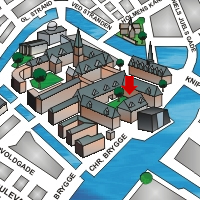
The Royal Library is located opposite The
Danish Parliament and Christiansborg Castle.
The
Royal Library
Address:
The Royal Library
Søren Kierkegaards Plads 1
DK-1016 København K
|
|
|