Liberty Memorial - Copenhagen

*A Part of the Danish Cultural Heritage*


Liberty Memorial
Return Interactive Map Sightseeing Index Return previous
 
Online & Onsite Sightseeing - Copenhagen
 
Liberty Memorial - Copenhagen


See - if time
 

The Liberty Memorial from 1797 symbolizes the abolishment of adscription in 1788.


The Liberty Memorial


The Liberty Memorial is placed on Vesterbrogade opposite the Grand Central Station and was erected in 1797 on its present location, which was at that time far outside the ramparts of the city. Five years earlier Prince Frederik – later King Frederik VI had laid the foundation stone in 1792 as a symbolic gesture to commemorate the abolishment of adscription in 1788. Adscription was introduced in Denmark in 1733, binding the farmers and workers to the estate where they were born and preventing them from leaving the properties without the permission of the landowners.


Gift to the city from reform-seeking citizens
The Liberty monument was given as a gift in 1791 to the city from the bourgeoisie of Copenhagen and reform-seeking citizens who wished to celebrate the formal freedom of the farmers that were lawfully tied up with their landowners. The Liberty Memorial was also erected by the people to honour King Christian VII for abolishing adscription and for his efforts on supporting agricultural reforms.

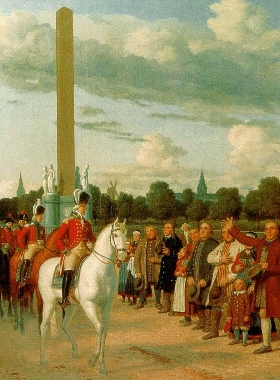
King Christian VII and Prince Frederik (VI) celebrating the inauguration of the Liberty Memorial in 1797 together with citizens and farmers, who collected founds in 1791 to build this "Peasant Freedom Monument". The erection of the monument was also the start of a new democratic era in Denmark.
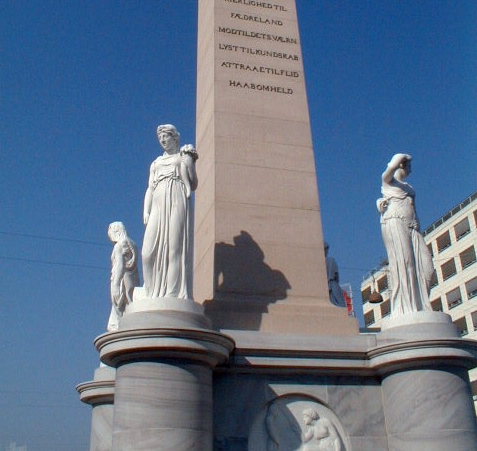
The Liberty Memorial from 1797 with the four figures symbolizing Fidelity - Justice - Virtue and Courage. The monument is created by sculptor Nicolai Abildgaard and was placed way outside and beyond the ramparts of Copenhagen city - and nearly on the same spot as the monument is placed today.

The germinating democratic movement in Denmark from 1788 to 1849
Actually, the Liberty monument is also a symbol of a germinating democratic movement in Denmark from 1788 to 1849, which slowly turned the Danish Kingdom into a democratic nation, in spite of being a territorial state in a strict absolutist form during this period.
The King‘s unrestricted authority was subsequently codified in the Royal Law (Kongeloven) of 1665, which in general remained in force until the abolition of absolutism in 1848 and the adoption of a democratic constitution in 1849. This legislative achievement resulted in the formation of the Danish constitutional monarchy and led to King Frederik VII declaring himself as the first constitutional King, which was codified in The Constitution of the Kingdom of Denmark of 5 June 1849.

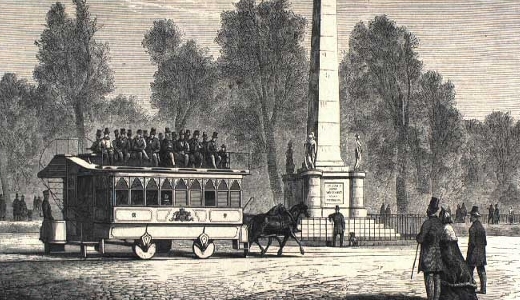
The Liberty Memorial was a landmark for Copenhageners - here illustrated in 1863, with the horse driven tramcar and tracks that ran on both sides of the monument. The tramcar line went through the city between the Liberty Memorial and Frederiksberg and was opened 22 October 1963. The tramcar service was operated by Copenhagen Railway Company and was the first tramcar route in Denmark.

Introduction of the Danish constitution in 1849
With the introduction of the first Danish democratic constitution in 1849 based upon a parliamentary liberal democracy, and a national citizenship founded on a universal set of rights and obligations, the growing democratic movement and freedom-loving Danes had achieved their goals in a peacefully manner.


Four Danish Kings and the new democratic era - 1788-1849
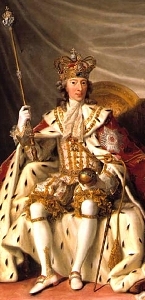
King Christian VII - 1749-1808 - King of Denmark and Norway 1766-1808.
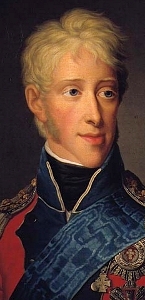
King Frederik VI -
1768-1839 - King of Denmark and Norway 1808-1839.
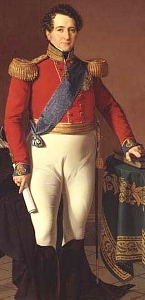
King Christian VIII - 1786-1848 - King of Denmark 1839-1848.
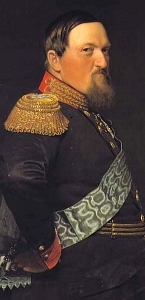
King Frederik VII -
1808-1863 - King of Denmark 1848-1863.
Four Danish Kings – King Christian VIIKing Frederik VIKing Christian VIII and King Frederik VII - all from the Royal House of Oldenborg were more or less involved in this new democratic era starting with the year when abolition of adscription took place in 1788, up to the abolition of absolutism was a reality in 1848 and until the Constitution was finally signed in June 1849.

Move 5,5 meters to new location
Due to trafficable conditions of the railway system to the Central Station the Liberty memorial was moved 5, 5 meters towards the Town Hall Square and inaugurated again in 1909. In 2000 the monument was given a major overhaul and celebrated with a ceremony.

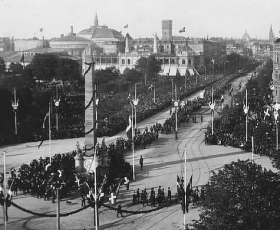
Opening ceremony of the Liberty Memorial at Vesterbrogade in 1909 - when the monument was moved 5,5 meters towards the Town Hall to give place for a new railway line from the old Central Station to the new - which was opened in 1911.
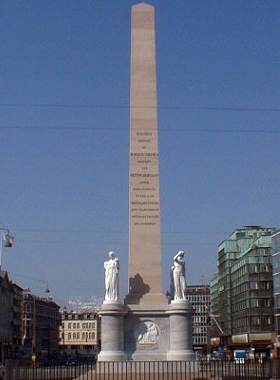
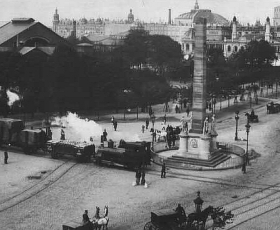
The Liberty Memorial at its final and present location in 1910 with the railway tracks to the Central Station. The 20 meter obelisk and the four figures surrounding the monument went through a major overhaul in 2000.

Brief data
The Liberty Memorial is created in 1797 as a 20 meter obelisk in Italian and Polish marble together with sandstone from the isle of Bornholm and surrounded by four 220 cm high figures symbolizing Fidelity - Justice -
Virtue and Courage.

Location
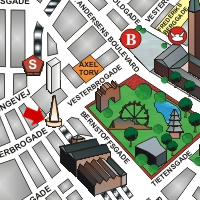
The Liberty Memorial is located just opposite the Central Station and near Tivoli and the Town Hall.

Liberty Memorial


Address
Vesterbrogade
Copenhagen

Busses: 10 - 15 - 26 - 30 - 40 - 66 - 2A - 5A - 6A - 250S

Trains – Central Station

The Liberty Memorial - Copenhagen
 
Return Interactive Map Sightseeing Index Return previous


Copenhagen-Portal © - Sponsored and operated by GBM MARKETING ApS - Disclaimer